you built the company. who's building the business?
I think most business owners are really good at the thing their company does. They're excellent plumbers or realtors or software developers or accountants, and they built their companies around that skill, hired people, won clients, and grew.
However, after ten-plus years working in a variety of fields and for a number of exciting and innovative leaders, what almost none of them learned along the way is how to build and run the actual business; the operations. The systems. The strategy that connects what you sell to how you sell it to who you keep. They skipped the basement and went straight to framing the house.
I get why. Strategy feels abstract when there are invoices to send, clients to call, and fires to put out. Founders want results; they want the house. Nobody wants to pour concrete…but a house without a basement is just waiting for the ground to shift.

Exhibit III, "Organization Practices During Evolution in the Five Phases of Growth," from Larry E. Greiner, "Evolution and Revolution as Organizations Grow," Harvard Business Review, July-August 1972.
With one recent client this problem had a price tag. The firm had several team members and a strong market presence, but no defined service categories, no segmented client profiles, and no framework for targeting either with any precision. During my tenure, I worked with leadership to develop and secure the largest business opportunity in the company's history, which was then lost, after my departure, due in large part to these missing structures. This is the work Finlay Consulting was founded to address; growing companies reach a "crisis of autonomy," as described by Larry Greiner in his 1972 article, Evolution and Revolution as Organizations Grow. In it, he describes an inflection point where the founder's instincts and relationships become constraints on its ability to scale. The marketing function is reactive because nobody has defined the audiences or the strategy behind it. Operations run on institutional memory rather than documented process. Client retention is managed by feel rather than by system. Revenue grows and the foundation stays the same.
My work is in building what's missing: marketing systems, operational process, retention infrastructure. These are the structural layers that allow a company to grow beyond what one person can hold together. This insights blog will document the problems I encounter, the patterns I observe, and the frameworks I apply in solving them. If your company has reached the point where growth has started to feel like a liability rather than a reward, this work may be relevant to you.
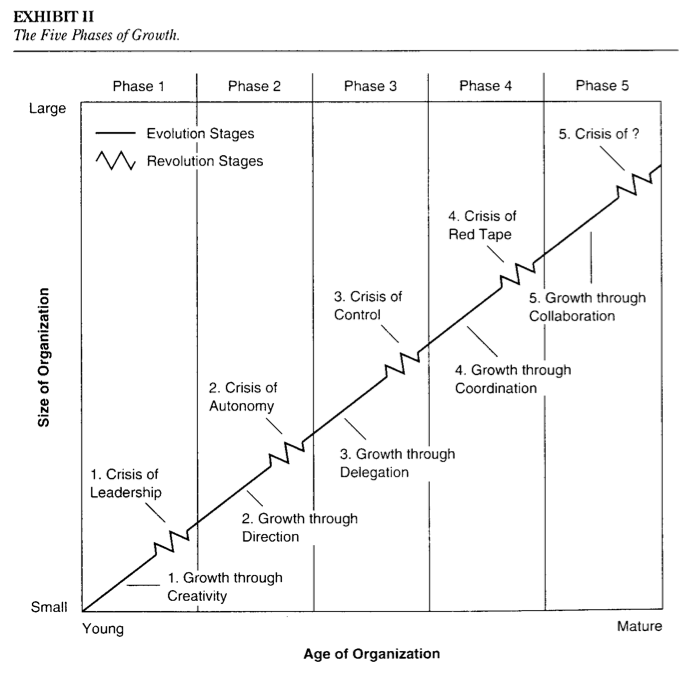
Exhibit II, "The Five Phases of Growth," from Larry E. Greiner, "Evolution and Revolution as Organizations Grow," Harvard Business Review, July-August 1972.
Finlay Consulting is active on LinkedIn, where we share observations on marketing, operations, and the challenges of scaling founder-led businesses. If this piece resonated, connect with us there.